



code
Cheapest LLM models in the Jantaris catalog (2026)
The cheapest LLM models in the Jantaris catalog, from DeepSeek V4 Flash and GPT-6 Luna to Claude, ranked by the cost of 1,000 chat replies, with a script.
 Piotr Olszewski2026-10-027 minPolski

The cheapest LLM models in the Jantaris catalog (as of October 12, 2026) are DeepSeek V4 Flash ($0.135 / $0.27 per 1M tokens) and GPT-6 Luna ($0.108 / $0.54 per 1M tokens), followed by GPT-5.6 Luna, DeepSeek V4 Pro, MiniMax M3, Gemini 3.6 Flash and GLM-5.2. On a workload of 1,000 support-chat replies, the spread between the cheapest and the most expensive chat model in the catalog is huge. Below is the formula I used, the ranked list, and a script that recomputes it for your own numbers.
A caveat first: this ranks cost, not quality. The cheapest model is not always good enough, but for many jobs (classification, summaries, simple answers) a budget model does the work for a fraction of a flagship's price.
The method: 1,000 chat replies
The example assumes a support chatbot with a short knowledge-base excerpt in the prompt:
- 1,000 replies,
- on average 1,500 input tokens per reply (system prompt, knowledge-base excerpt, the customer's question),
- on average 400 output tokens per reply.
That is 1.5M input tokens and 0.4M output tokens in total. Prices are per 1M tokens, so the formula collapses to:
cost of 1,000 replies = 1.5 × input rate + 0.4 × output rateThe general version for any workload:
cost = replies × (input tokens × input rate + output tokens × output rate) / 1,000,000Each model's input and output rates are in the table below and on the pricing page.
Ranking: the cheapest LLM models in the Jantaris catalog
The order of the table is the formula above at Jantaris catalog prices as of October 12, 2026, from the cheapest model down. The rates in the "Price" column are always live, so the order can shift after a price change. You can get the amount for your own numbers in the AI cost calculator or with the script further down.
| Model | Vendor | Price per 1M tokens (input / output) |
|---|---|---|
| DeepSeek V4 Flash | DeepSeek | $0.135 / $0.27 per 1M tokens |
| GPT-6 Luna | OpenAI | $0.108 / $0.54 per 1M tokens |
| GPT-5.6 Luna | OpenAI | $0.216 / $1.30 per 1M tokens |
| DeepSeek V4 Pro | DeepSeek | $0.54 / $1.22 per 1M tokens |
| MiniMax M3 | MiniMax | $0.81 / $3.24 per 1M tokens |
| Gemini 3.6 Flash | $0.79 / $3.95 per 1M tokens | |
| GLM-5.2 | Z.ai | $1.22 / $4.05 per 1M tokens |
| Claude Haiku 4.5 | Anthropic | $1.35 / $6.75 per 1M tokens |
| Claude Sonnet 5 | Anthropic | $3.24 / $16.20 per 1M tokens |
| Kimi K3 | Moonshot AI | $3.38 / $16.88 per 1M tokens |
| Claude Opus 5.5 | Anthropic | $3.78 / $18.90 per 1M tokens |
The top two depend on your input-to-output ratio: GPT-6 Luna has the cheaper input, DeepSeek V4 Flash the much cheaper output. In this example Flash wins, but once input is more than 10 times the output, Luna comes out cheaper. I added Claude Sonnet 5 and Opus 5.5 for scale. Plug their rates into the formula and you see right away what the same work costs on a flagship.

What the ranking does not show
The formula is exact, but the example's assumptions do not fit every model equally. Four things change the real bill:
- Reasoning tokens. Thinking models (GPT-6 and DeepSeek with thinking on, among others) generate thinking tokens that are billed as output. Then 400 output tokens can turn into several thousand.
- Different tokenizers. The same text is a different number of tokens in different models. Anthropic, for example, says Sonnet 5 counts the same text as about 30% more tokens than Sonnet 4.6.
- Output caps. Gemini 3.6 Flash is capped at 8,192 output tokens per reply in Jantaris. Fine for chat, not for long reports.
- Quality and rework. A cheap model that gets one answer in five wrong can end up costing more if a human or a second, pricier model fixes every mistake.
So I treat the ranking as a shortlist for testing, not a verdict. I show how to run the same questions through several models at once in One LLM API in Python and Node.
The budget models in brief
DeepSeek V4 Flash. The smaller model in the DeepSeek V4 family, with open weights. 1M-token context, up to 384K output tokens and the lowest output rate in the chat catalog. It thinks before answering by default and thinking tokens are billed as output, so set max_tokens on simple tasks.
GPT-6 Luna. The cheapest model in the GPT-6 family (September 2026), for chat, classification and light agents, with a 1.05M-token context. The whole family is covered in GPT-6 API pricing.
MiniMax M3. An open-weight model from May 2026 for coding and agents, with a 1M-token context and replies up to 512K tokens. A good candidate when you need long outputs (whole files, reports) on a budget.
DeepSeek V4 Pro. A large open-weight MoE model, V4 Flash's bigger sibling. At October 12, 2026 prices it costs several times more than Flash on Jantaris for both input and output, so pick it only where your own data shows a clearly better result.
GLM-5.2 (Z.ai). An open-weight model for long, planned tasks.
Gemini 3.6 Flash. A fast model from Google's Flash line for chat and simple tasks. On Jantaris it is capped at 8,192 output tokens, so pick another model for long reports.
Kimi K3. It is here because it comes up in searches for cheap models, but in Jantaris it is not among the cheapest: at October 12, 2026 prices it costs more than Claude Sonnet 5. It is a model for long, hard projects, not high-volume chat.
Script: rank models for your own numbers
The public GET /v1/models endpoint returns live prices without an API key. This script computes the cost for your assumptions and sorts models from cheapest:
import requests

REPLIES, IN_TOK, OUT_TOK = 1000, 1500, 400  # your numbers here

models = requests.get(
    "https://jantaris.com/v1/models",
    params={"category": "chat", "currency": "USD"},
    timeout=30,
).json()["data"]

rows = []
for m in models:
    p = m["pricing"]
    cost = REPLIES * (IN_TOK * float(p["input_per_mtok"]) + OUT_TOK * float(p["output_per_mtok"])) / 1_000_000
    rows.append((cost, m["id"]))

for cost, model_id in sorted(rows):
    print(f"{model_id:24} ${cost:8.2f}")
Take your average token counts from real traffic. Every API response has a usage field with prompt_tokens and completion_tokens, so logging them for a few days is enough.
How to pay less on any model
- Short system prompt. It is sent with every reply. In the example above it makes up most of the 1,500 input tokens.
- Routing. A cheap model handles most questions, a pricier one only the cases the cheap one cannot. Switching models is one line.
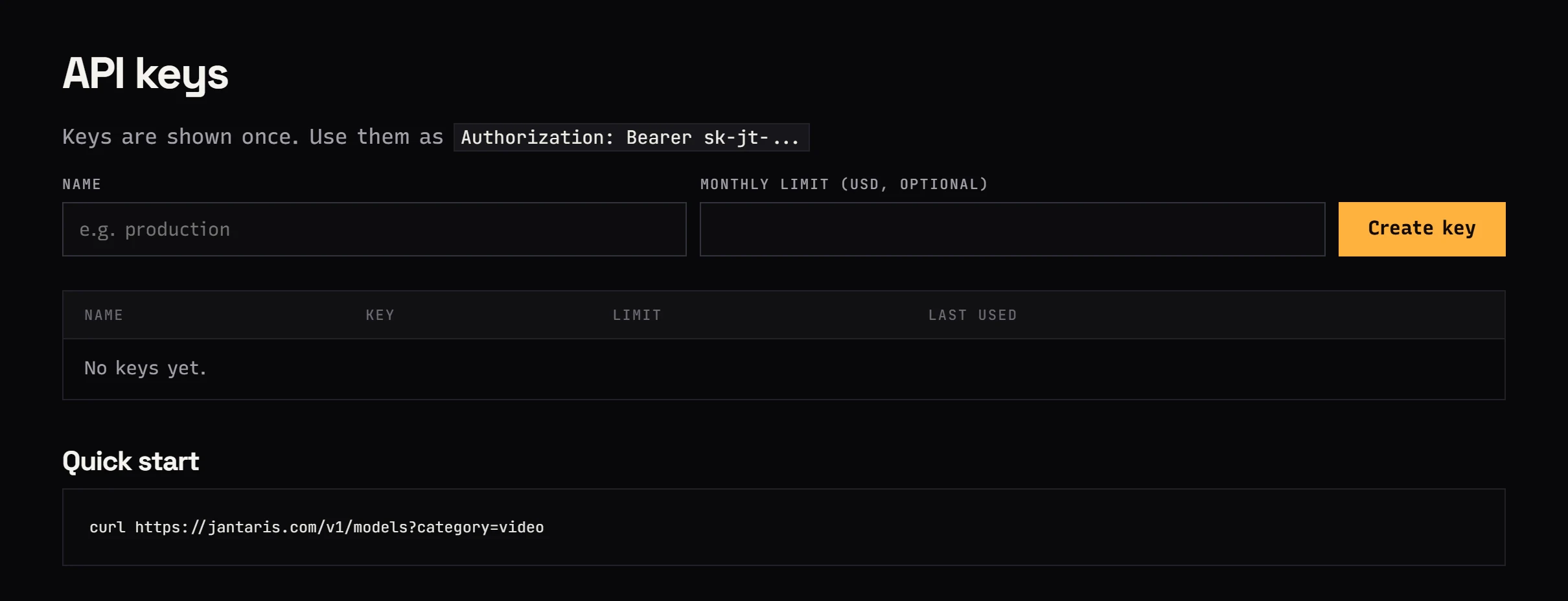
max_tokens. Cap the reply length where answers should be short.- Per-key limits. In the dashboard you set a monthly spend limit on each API key. When it is reached, the API returns
403.
In Jantaris all of these models sit behind one key and one prepaid balance: no subscription, the balance never expires, failed requests cost nothing. The minimum top-up is $10, and at the rates above that covers many thousands of replies on the budget models. You can sign up here.
FAQ
Which LLM model is the cheapest on Jantaris?
At October 12, 2026 prices, for 1,000 replies of 1,500 input and 400 output tokens, the cheapest in the Jantaris catalog is DeepSeek V4 Flash ($0.135 / $0.27 per 1M tokens), followed by GPT-6 Luna ($0.108 / $0.54 per 1M tokens) and GPT-5.6 Luna ($0.216 / $1.30 per 1M tokens). With a different input-to-output mix the order can change: once input is more than 10 times the output, GPT-6 Luna comes out cheaper than Flash. The AI cost calculator gives the amount for your own numbers.
How much do 1,000 chatbot replies cost?
Use the formula 1.5 × input rate + 0.4 × output rate (for 1,500 input and 400 output tokens per reply). The gap between the cheapest and the most expensive model in the table is very large, so run the numbers for your own workload. The AI cost calculator shows the current amount for your own numbers.
Is a cheap model good enough for customer support?
Often, especially for simple questions and classification. Test it on a few dozen real conversations and route the hard cases to a stronger model.
Why is my bill higher than the ranking suggests?
Usually because of reasoning tokens, long chat history or a longer prompt than you assumed. Check usage in your responses and plug the real numbers into the formula.
Is there a free LLM API?
Jantaris has no free plan and no starter credit. You pay from the first request, the minimum top-up is $10, the balance never expires and failed requests are not charged.


