











Cheapest LLM API in 2026 - Cost of 1,000 Chat Replies Ranked
The cheapest LLM APIs in 2026 (DeepSeek V4, Gemini Flash, GLM, Kimi, MiniMax, Qwen) ranked by the cost of 1,000 chat replies, with formula and script.
 Piotr Olszewski2026-10-027 minPolski
The cheapest LLM APIs in the Jantaris catalog are DeepSeek V4.1 Flash ($0.54 / $1.75 per 1M tokens) and GPT-6 Luna ($0.108 / $0.54 per 1M tokens), followed by MiniMax M3, DeepSeek V4 Pro, GLM-5.2 and the Gemini Flash models. On a workload of 1,000 support-chat replies, the most expensive chat models in the catalog cost more than 100 times as much as the cheapest. Below is the formula I used, the ranked list, and a script that recomputes it for your own numbers.
A caveat first: this ranks cost, not quality. The cheapest model is not always good enough, but for many jobs (classification, summaries, simple answers) a budget model does the work for a fraction of a flagship's price.
The method: 1,000 chat replies
The example assumes a support chatbot with a short knowledge-base excerpt in the prompt:
- 1,000 replies,
- on average 1,500 input tokens per reply (system prompt, knowledge-base excerpt, the customer's question),
- on average 400 output tokens per reply.
That is 1.5M input tokens and 0.4M output tokens in total. Prices are per 1M tokens, so the formula collapses to:
cost of 1,000 replies = 1.5 × input rate + 0.4 × output rateThe general version for any workload:
cost = replies × (input tokens × input rate + output tokens × output rate) / 1,000,000Each model's input and output rates are in the table below and on the pricing page.
Ranking: the cheapest LLM APIs in Jantaris
The "Relative cost" column is the formula above at catalog prices as of October 2, 2026, shown as a multiple of the cheapest model (DeepSeek V4.1 Flash = 1×). The rates in the "Price" column are always live, and you can get the amount for your own numbers in the AI cost calculator or with the script further down.
| Model | Vendor | Price per 1M tokens (input / output) | Relative cost of 1,000 replies |
|---|---|---|---|
| DeepSeek V4.1 Flash | DeepSeek | $0.54 / $1.75 per 1M tokens | 1× |
| GPT-6 Luna | OpenAI | $0.108 / $0.54 per 1M tokens | 1.7× |
| GPT-5.6 Luna | OpenAI | $0.216 / $1.30 per 1M tokens | 3.7× |
| MiniMax M3 | MiniMax | $0.81 / $3.24 per 1M tokens | 5.5× |
| DeepSeek V4 Pro | DeepSeek | $2.35 / $4.70 per 1M tokens | 10× |
| GLM-5.2 | Z.ai | $1.22 / $4.05 per 1M tokens | 11× |
| Gemini 3.6 Flash | $0.79 / $3.95 per 1M tokens | 12× | |
| gemini-3.8-flash | 16× | ||
| Claude Haiku 4.5 | Anthropic | $1.35 / $6.75 per 1M tokens | 21× |
| glm-5.3 | Z.ai | 23× | |
| grok-4.7 | xAI | 26× | |
| qwen3.8-max | Alibaba | 32× | |
| Claude Sonnet 5 | Anthropic | $3.24 / $16.20 per 1M tokens | 42× |
| Kimi K3 | Moonshot AI | $4.05 / $20.25 per 1M tokens | 62× |
| Claude Opus 5.5 | Anthropic | $5.40 / $27.00 per 1M tokens | 83× |
I added Claude Sonnet 5 and Opus 5.5 for scale. The same work on Opus costs about 83 times more than on DeepSeek V4.1 Flash.

What the ranking does not show
The formula is exact, but the example's assumptions do not fit every model equally. Four things change the real bill:
- Reasoning tokens. Thinking models (GPT-6, DeepSeek with thinking on, Gemini 3.8 Flash at higher effort, among others) generate thinking tokens that are billed as output. Then 400 output tokens can turn into several thousand. Google says outright that Gemini 3.8 Flash uses more tokens on long, complex tasks.
- Different tokenizers. The same text is a different number of tokens in different models. Anthropic, for example, says Sonnet 5 counts the same text as about 30% more tokens than Sonnet 4.6.
- Output caps. Gemini 3.6 Flash is capped at 8,192 output tokens per reply in Jantaris. Fine for chat, not for long reports.
- Quality and rework. A cheap model that gets one answer in five wrong can end up costing more if a human or a second, pricier model fixes every mistake.
So I treat the ranking as a shortlist for testing, not a verdict. I show how to run the same questions through several models at once in One LLM API in Python and Node.
The budget models in brief
DeepSeek V4.1 Flash. DeepSeek's September 2026 model, the smallest in its new architecture. 1M-token context, up to 384K output tokens, open weights. DeepSeek built it for input-heavy work such as agents that read a lot of code before each change.
GPT-6 Luna. The cheapest model in the GPT-6 family (September 2026), for chat, classification and light agents, with a 1.05M-token context. The whole family is covered in GPT-6 API pricing.
MiniMax M3. An open-weight model from May 2026 for coding and agents, with a 1M-token context and replies up to 512K tokens. A good candidate when you need long outputs (whole files, reports) on a budget.
DeepSeek V4 Pro. A large open-weight MoE model. Cheap input, noticeably pricier output than the Flash model, so it pays off where the model reads a lot and writes little.
GLM-5.2 and GLM 5.3 (Z.ai). Both open-weight. GLM-5.2 is the cheaper option for long, planned tasks. GLM 5.3 is the flagship with a 1.31M-token context, aimed at coding and agents.
Gemini 3.6 Flash and 3.8 Flash. Google calls 3.8 Flash its most capable Flash model, with a context of about 1M tokens and replies up to 64K tokens. Google labels its current price as introductory until December 31, 2026, so check the pricing again in January.
Kimi K3 and Qwen3.8 Max. Both are here because they come up in searches for cheap models, but in Jantaris they are not among the cheapest. Qwen3.8 Max costs about as much as mid-tier models, and Kimi K3 more than Claude Sonnet 5. They are models for long, hard projects, not high-volume chat.
Script: rank models for your own numbers
The public GET /v1/models endpoint returns live prices without an API key. This script computes the cost for your assumptions and sorts models from cheapest:
import requests

REPLIES, IN_TOK, OUT_TOK = 1000, 1500, 400  # your numbers here

models = requests.get(
    "https://jantaris.com/v1/models",
    params={"category": "chat", "currency": "USD"},
    timeout=30,
).json()["data"]

rows = []
for m in models:
    p = m["pricing"]
    cost = REPLIES * (IN_TOK * float(p["input_per_mtok"]) + OUT_TOK * float(p["output_per_mtok"])) / 1_000_000
    rows.append((cost, m["id"]))

for cost, model_id in sorted(rows):
    print(f"{model_id:24} ${cost:8.2f}")
Take your average token counts from real traffic. Every API response has a usage field with prompt_tokens and completion_tokens, so logging them for a few days is enough.
How to pay less on any model
- Short system prompt. It is sent with every reply. In the example above it makes up most of the 1,500 input tokens.
- Routing. A cheap model handles most questions, a pricier one only the cases the cheap one cannot. Switching models is one line.
max_tokens. Cap the reply length where answers should be short.- Per-key limits. In the dashboard you set a monthly spend limit on each API key. When it is reached, the API returns
403.
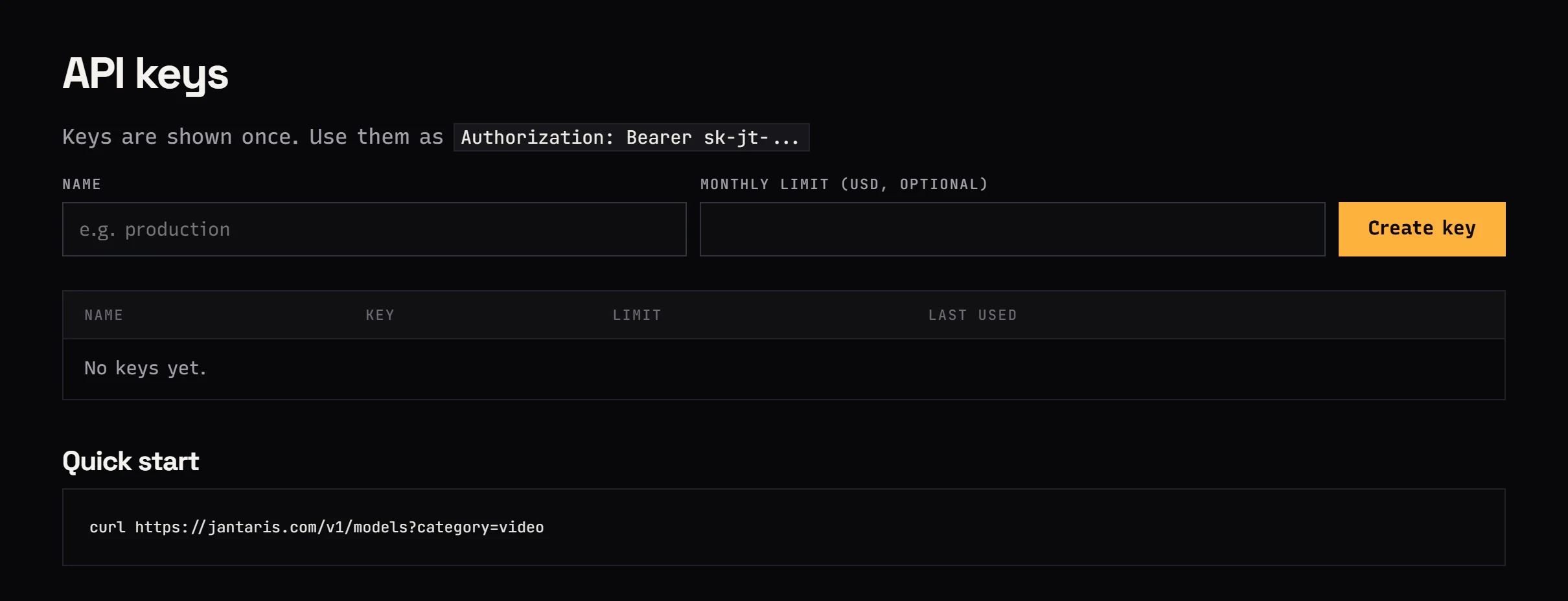
In Jantaris all of these models sit behind one key and one prepaid balance: no subscription, the balance never expires, failed requests cost nothing. The minimum top-up is $10, and at the rates above that covers many thousands of replies on the budget models. You can sign up here.
FAQ
What is the cheapest LLM API in 2026?
In the Jantaris catalog the cheapest is DeepSeek V4.1 Flash ($0.54 / $1.75 per 1M tokens), followed closely by GPT-6 Luna ($0.108 / $0.54 per 1M tokens). For 1,000 replies of 1,500 input and 400 output tokens, GPT-6 Luna comes out about 1.7 times the cost of DeepSeek V4.1 Flash (prices as of October 2, 2026). The AI cost calculator gives the amount for your own numbers.
How much do 1,000 chatbot replies cost?
Use the formula 1.5 × input rate + 0.4 × output rate (for 1,500 input and 400 output tokens per reply). At October 2, 2026 prices, Claude Opus 5.5 comes out about 83 times the cost of DeepSeek V4.1 Flash. The AI cost calculator shows the current amount for your own numbers.
Is a cheap model good enough for customer support?
Often, especially for simple questions and classification. Test it on a few dozen real conversations and route the hard cases to a stronger model.
Why is my bill higher than the ranking suggests?
Usually because of reasoning tokens, long chat history or a longer prompt than you assumed. Check usage in your responses and plug the real numbers into the formula.
Is there a free LLM API?
Jantaris has no free plan and no starter credit. You pay from the first request, the minimum top-up is $10, the balance never expires and failed requests are not charged.


