











Kling 3.0 API Pricing - Cost per Second and per 5-15 s Clip
Kling 3.0 API pricing per second at 720p, 1080p and 4K, what a 5, 10 or 15 second clip costs, what audio adds, plus Turbo and Motion Control.
 Piotr Olszewski2026-10-028 minPolski
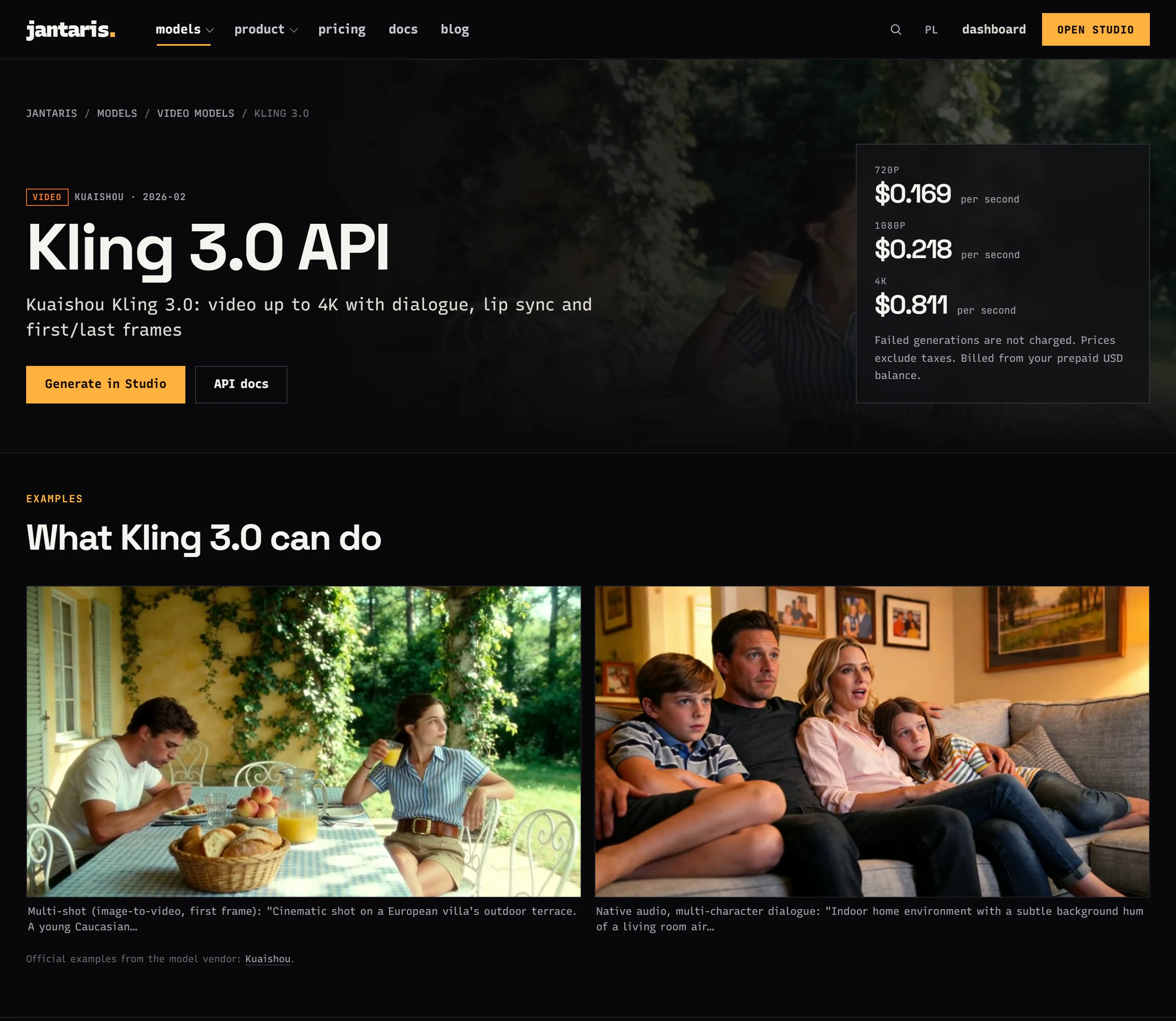
Kling 3.0 on Jantaris costs from $0.169 per second, billed only for the seconds of video you actually get, with no subscription and no monthly credits that expire. That lowest rate is for 720p; 1080p costs roughly a third more per second, and 4K close to five times the 720p rate. Below: what drives the price, what typical 5, 10 and 15 second clips cost, and the exact API calls.
How Kling 3.0 API pricing works
Kling 3.0 is Kuaishou's video model released in February 2026. On Jantaris it is billed per second of output, and the rate depends on one thing: resolution. Kuaishou's app calls the tiers Standard, Pro and 4K. In the API you pick them with the resolution field:
resolution | Kuaishou tier | Rate per second |
|---|---|---|
720p | Standard (std) | lowest: from $0.169 per second |
1080p (default) | Pro | about 1.3 × the 720p rate |
4k | 4K | about 4.8 × the 720p rate |
The exact figures for every resolution are listed on the Kling 3.0 model page and on the pricing page. Prices on the global site are in USD, excluding taxes.
Three more things change what you pay:
- Duration. Clips run from 3 to 15 seconds (default 6). Cost is rate times seconds, nothing else.
- Audio. Kling 3.0 can generate dialogue with lip sync and ambient sound (
generate_audio: true). Kuaishou charges more for sound, so the per-second rate with audio on is roughly 1.4-1.5 times higher. Studio andestimated_costalready include it when you switch audio on. If you add music or a voiceover in your editor anyway, leave audio off. - Failures. A task that ends as
failedcosts $0 and the hold on your balance is released in full. A finished clip you don't like is still a successful generation and is charged.
What a 5, 10 or 15 second Kling clip costs
The math is linear. Here is how I think about typical lengths:
| Clip | Seconds billed | What I use it for |
|---|---|---|
| 5 s at 720p | 5 × 720p rate | prompt test, checking camera motion |
| 5 s at 1080p | 5 × 1080p rate | B-roll, social cutaway |
| 10 s at 1080p | 10 × 1080p rate | dialogue scene, product shot |
| 15 s at 1080p | 15 × 1080p rate | a full short from one task |
| 15 s at 4K | 15 × 4K rate | hero shot for a campaign |
The Studio form shows the price before you hit "Generate": in the screenshot further down, 6 seconds at 1080p without audio. Through the API the same number comes back as estimated_cost the moment you submit a task.
My own routine: iterate on 5 seconds at 720p, then render the one take I like at 1080p or 4K at full length. Since 4K is almost five times the 720p rate, tweaking prompts directly in 4K burns money fast.
Kling 3.0 API vs a Kling AI subscription
In Kuaishou's app Kling is sold as monthly plans with a credit pool, while on Jantaris you pay per second from a balance that never expires. The plans, how long credits last and when each billing model pays off are covered in Kling AI without a subscription. Per-second costs across other video models are in AI video cost per second.
What Kling 3.0 can do
Parameters on Jantaris:
- 3 to 15 second clips,
- 16:9, 9:16 or 1:1 (with a start frame, the image's ratio wins),
- 720p, 1080p or 4K,
- start frame (
image_url) and end frame (end_image_url) for a controlled transition, - up to 2 reference images (
image_urls), - optional audio with dialogue, lip sync and ambience,
- prompts up to 2,500 characters.
Kuaishou lists Chinese, English, Japanese, Korean and Spanish as speech languages for 3.0. Where Kling shines is people: several shots described in one prompt and characters who talk. Two official samples show it well.
My own test on 27 September 2026 was less flattering. I gave base Kling 3.0 two prompts that several other video models also got: coffee poured into a cup, and a yellow-and-red Warsaw tram in the rain at dusk. The clips came out sharp at 1080p, but prompt adherence was the weakest point: the coffee level barely rose in 4 seconds, and the tram was cream instead of yellow, lit like an overcast afternoon rather than dusk. I scored them 7.0 and 6.5 out of 10. Two shots are not a verdict, but with Kling I now spell out colors and time of day twice.


Kling 3.0 vs Turbo vs Motion Control
| Model | Use it for | Billed on | Price |
|---|---|---|---|
| Kling 3.0 | text or image, 3-15 s, up to 4K, audio | output seconds | from $0.169 per second |
| Kling 3.0 Turbo | faster 720p/1080p clips, no audio | output seconds | from $0.277 per second |
| Kling 3.0 Motion Control | motion from your video onto a character from a photo | source video seconds | $0.249 per second |
| Kling 2.6 Motion Control | the same, budget tier | source video seconds | $0.138 per second |
What the names don't tell you:
- Turbo is not the cheap option. At the time of writing, Kling 3.0 Turbo has a higher per-second rate than Kling 3.0 at 720p. You pay for speed and get less: no audio, no 4K, start frame only. I use it when turnaround time matters more than features.
- Motion Control bills the input clip, not the output. In Jantaris the character's orientation follows the image, so the motion source can be 3-10 seconds (the vendor's 3-30 s video-orientation mode is not available yet).
proquality costs more thanstd; the final amount is incostonce the task finishes. - Motion Control 3.0 keeps faces more consistent than 2.6, as the vendor samples below show. 2.6 is fine for choreography tests and simple mascot animation.
- Kling 4.0 was announced by Kuaishou on 28 September 2026. As I write this, it is not in the Jantaris catalog.
Generating with Kling in Studio
- Open Jantaris Studio and pick Kling 3.0.
- Write the prompt: place, action, camera move. Put spoken lines in quotes.
- Set aspect ratio, resolution and a duration between 3 and 15 seconds.
- Tick "Generate audio" if you want dialogue or ambience.
- Optionally paste a start frame URL or upload a file. End frame and 2 reference images sit in the collapsed fields below.
- Check the "Cost" line, then click "Generate".
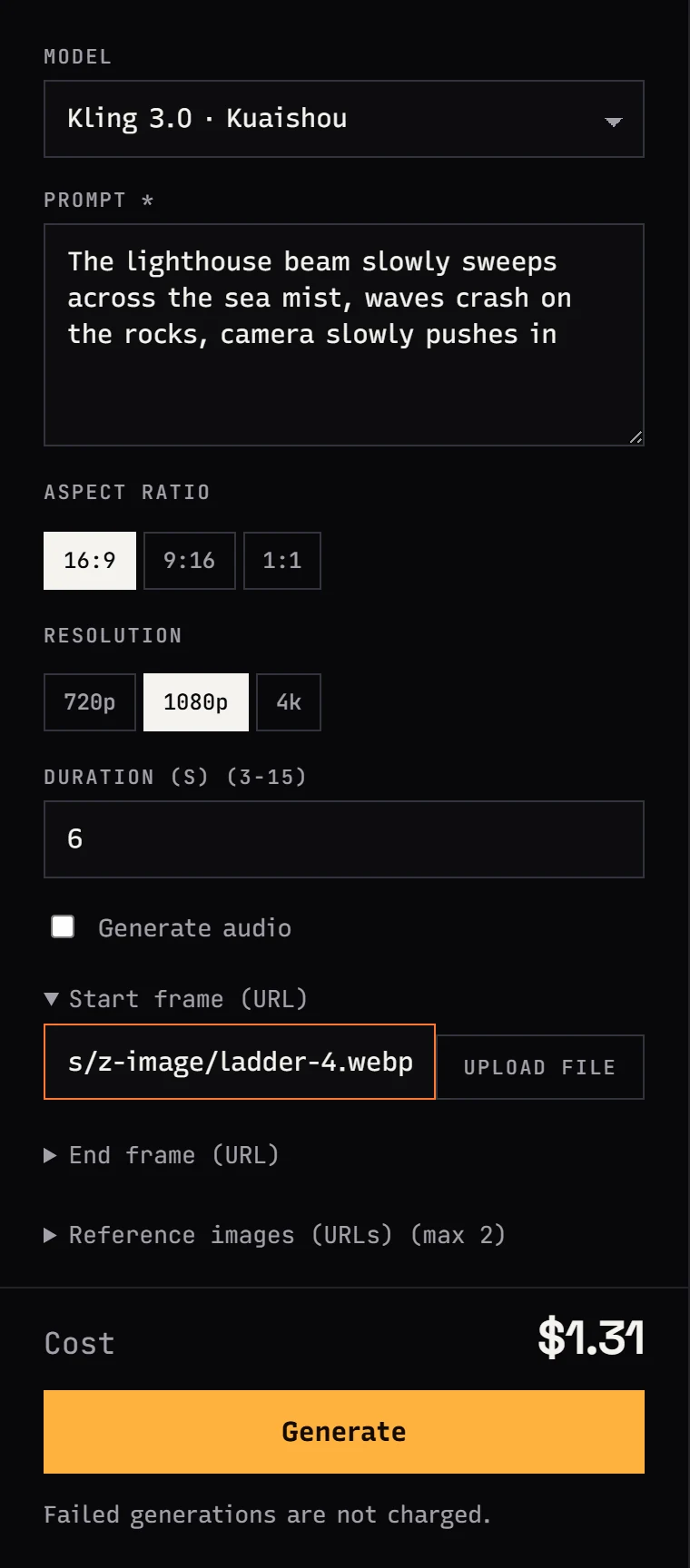
Clips stay in your generation history. For more on animating stills, see the image-to-video guide.
Kling 3.0 API example
Create a key (sk-jt-...) in the dashboard after signing up; the generate docs cover every field.
curl https://jantaris.com/v1/generate \
  -H "Authorization: Bearer $JANTARIS_API_KEY" \
  -H "Content-Type: application/json" \
  -d '{
    "model": "kling-3.0",
    "input": {
      "prompt": "Slow push-in on a lighthouse at night, the beam sweeps through thick fog, waves crash on the rocks",
      "image_url": "https://your-site.com/files/lighthouse.png",
      "duration": 5,
      "resolution": "720p",
      "generate_audio": false
    }
  }'
The 202 response carries the task id and estimated_cost. Polling in Python, with a talking scene this time:
import os, time, requests

API = "https://jantaris.com/v1"
H = {"Authorization": f"Bearer {os.environ['JANTARIS_API_KEY']}"}

task = requests.post(f"{API}/generate", headers=H, json={
    "model": "kling-3.0",
    "input": {
        "prompt": "A woman at a cafe table looks up and says \"I knew you'd come back.\" Soft window light, handheld",
        "duration": 10,
        "resolution": "1080p",
        "aspect_ratio": "9:16",
        "generate_audio": True,
    },
}).json()
print("estimate:", task["estimated_cost"])

while task["status"] in ("queued", "running"):
    time.sleep(10)
    task = requests.get(f"{API}/tasks/{task['id']}", headers=H).json()

print(task["status"], task["cost"], [o["url"] for o in task["output"] or []])
For a transition between two frames, add end_image_url. For Motion Control, send kling-3.0-motion-control with the motion clip in video_url, the character photo in image_url and quality set to std or pro. GET /v1/models/kling-3.0 (public, no key) returns the full input schema and current prices. If you run many tasks at once, switch from polling to webhooks.
How Kling stacks up against Veo, Seedance and others on length, resolution and price is in the AI video API comparison.
FAQ
How much does the Kling 3.0 API cost?
On Jantaris, from $0.169 per second. That is the 720p rate; 1080p is about a third more per second and 4K close to five times as much. You pay only for seconds of finished video.
What does a 10 second Kling 3.0 video cost?
Ten times the per-second rate for the resolution you choose. The exact figure appears in the Studio "Cost" line, or in estimated_cost right after you submit through the API.
Is there a free Kling 3.0 API?
No, Jantaris has no free tier, and Kuaishou's free app plan and its limits are covered in Kling AI without a subscription.
Is Kling 3.0 Turbo cheaper than Kling 3.0?
Not on Jantaris at the time of writing. Turbo is faster but has a higher per-second rate than Kling 3.0 at 720p, and it drops audio, 4K and end frames.
How is Kling Motion Control billed?
Per second of the source motion clip you upload, not per second of output. In Jantaris the source clip can be 3-10 seconds.


